EDWARD MILES (1752-1828)
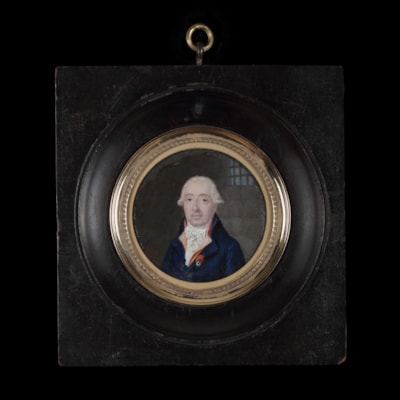
Prince Augustus Frederick, Duke of Sussex (1773-1843), wearing Windsor uniform (blue with red collar), white stock and star of the Garter
Watercolour on ivory (licence V3AJQRGE)
Oval, 3in. (75mm.) high
Ormolu frame
£5,500
 +44(0)7983510056

'Although the Prince is portrayed as robust in his portrait, in reality he was anything but. Suffering from chronic asthma, his illness was only alleviated by lengthy visits to the continent.'
This portrait of Prince Augustus, sixth son of George III, appears to be the only surviving variant in private hands. Another version of the Prince in Windsor uniform is in the Royal Collection, where it was first inventoried in 1870 and mistakenly ascribed to Richard Cosway. Two other miniatures with the same features but different clothing exist – another in the Royal Collection (wearing mushroom-coloured coat) and another at Calenberg (wearing Hanoverian uniform). Queen Victoria purchased an enamel copy of the miniature (RCIN 421912) by John Haslem (1808-1884), where the counter-enamel is erroneously inscribed as ‘After Cosway’.
The miniature was most likely painted prior to the Prince’s departure to the Mediterranean, where he resided from 1792-1804. Although the Prince is portrayed as robust in his portrait, in reality he was anything but. Suffering from chronic asthma, his illness was only alleviated by lengthy visits to the continent. Due to his poor health, he was unable to follow the more usual path of joining the army or navy but his time abroad conditioned his tastes and outlook on life.
The Prince’s relationship with his father was not close, partly dictated by the fact that he spent long periods away from his family and also by his radical, liberal political views. As a supporter of Catholic Emancipation, the abolition of the slave trade, parliamentary political reform and the Repeal of the Corn Laws the Prince could not have been more diametrically opposed to his father.
His estrangement was also due to the fact that, in 1793, he secretly married the Catholic Lady Augusta Murray in Rome. This was in direct contravention of the Royal Marriages Act of 1772 and George III declared the marriage null and void in 1794. Augusta and Augustus had two children together – Augustus Frederick (1794-1848) and Augusta Emma (1801-1866) who married Sir Thomas Wilde, later Lord Truro and Lord Chancellor.
In 1800 the Prince agreed to a separation from his wife finally and was rewarded by his father with the titles of Duke of Sussex, Earl of Inverness and Baron Arklow. He eventually remarried in 1840 Lady Cecilia Buggin, who became Duchess of Inverness on her marriage.
A charitable, enlightened and much liked man, the Prince had varied interests. He was a strong supporter of the Freemasons, becoming Grand Master of the United English Lodge. He also favoured the arts, being elected president of the Society of Arts in 1816, and from 1830 to 1838 was president of the Royal Society. He was a collector of books with his own library boasting over 50,000 volumes.
When the Prince died in April 1843, at Kensington Palace, The Times commented that ‘No death in the royal family short of the actual demise of a monarch could have occasioned a stronger feeling of deprivation’. In keeping with his liberal outlook, he was not interred with the royal family at Windsor, but was buried in the public cemetery at Kensal Green.
Edward Miles’ career as a painter took him from his birthplace in Yarmouth, Norfolk to Russia and finally to Philadelphia where he settled. From humble beginnings as an errand boy to a surgeon, Miles was eventually appointed miniature painter to the Duchess of York (1792) and later to Queen Charlotte.
The miniature was most likely painted prior to the Prince’s departure to the Mediterranean, where he resided from 1792-1804. Although the Prince is portrayed as robust in his portrait, in reality he was anything but. Suffering from chronic asthma, his illness was only alleviated by lengthy visits to the continent. Due to his poor health, he was unable to follow the more usual path of joining the army or navy but his time abroad conditioned his tastes and outlook on life.
The Prince’s relationship with his father was not close, partly dictated by the fact that he spent long periods away from his family and also by his radical, liberal political views. As a supporter of Catholic Emancipation, the abolition of the slave trade, parliamentary political reform and the Repeal of the Corn Laws the Prince could not have been more diametrically opposed to his father.
His estrangement was also due to the fact that, in 1793, he secretly married the Catholic Lady Augusta Murray in Rome. This was in direct contravention of the Royal Marriages Act of 1772 and George III declared the marriage null and void in 1794. Augusta and Augustus had two children together – Augustus Frederick (1794-1848) and Augusta Emma (1801-1866) who married Sir Thomas Wilde, later Lord Truro and Lord Chancellor.
In 1800 the Prince agreed to a separation from his wife finally and was rewarded by his father with the titles of Duke of Sussex, Earl of Inverness and Baron Arklow. He eventually remarried in 1840 Lady Cecilia Buggin, who became Duchess of Inverness on her marriage.
A charitable, enlightened and much liked man, the Prince had varied interests. He was a strong supporter of the Freemasons, becoming Grand Master of the United English Lodge. He also favoured the arts, being elected president of the Society of Arts in 1816, and from 1830 to 1838 was president of the Royal Society. He was a collector of books with his own library boasting over 50,000 volumes.
When the Prince died in April 1843, at Kensington Palace, The Times commented that ‘No death in the royal family short of the actual demise of a monarch could have occasioned a stronger feeling of deprivation’. In keeping with his liberal outlook, he was not interred with the royal family at Windsor, but was buried in the public cemetery at Kensal Green.
Edward Miles’ career as a painter took him from his birthplace in Yarmouth, Norfolk to Russia and finally to Philadelphia where he settled. From humble beginnings as an errand boy to a surgeon, Miles was eventually appointed miniature painter to the Duchess of York (1792) and later to Queen Charlotte.
Philip Mould & Co.;
Private Collection
Private Collection


shipping notice
Worldwide shipping is included in all prices.
The Limner Company does not accept any responsibility for import duty, this is to be paid by the buyer.
Some stock items contain materials from endangered species which are governed by CITES regulations and will require a permit to export outside of Great Britain. If a certificate of export is required then this will be the responsibility of and paid for by the buyer .
you may also like