

NEWS
By Guest blogger, Jacqui Ansell |
15 Jul 2026
Fashion in Hilliard's James I and VI
Hilliard delights in depicting details of dress, conveying the range of textured textiles and jewellery with breathtaking skill. Many contemporary artists captured the King’s love of white silk suits, and sitters would often leave clothing in the artist’s studio so that every aspect could be studied and recorded. As Hilliard shows us an identical doublet - but from a wider angle - in at least one other miniature it seems likely that this was a real garment rather than a figment of the artist’s imagination.
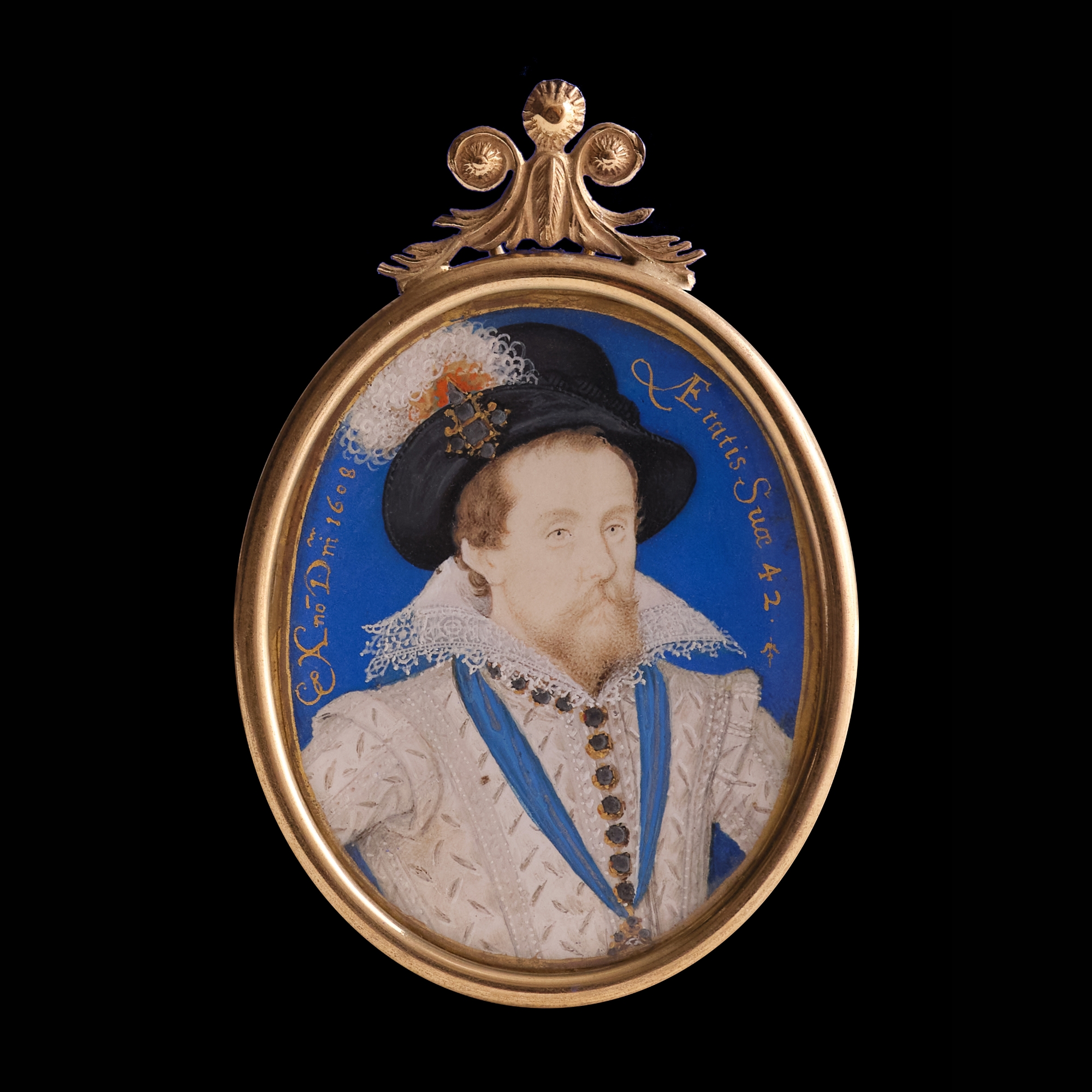
A doublet is so called as it is formed from double layers of cloth (as opposed to the word ‘singlet’ still – just about - in use today). The outer layer of silk is embellished with a regular pattern of small slashes. Before tailoring, the garment pieces would have been laid flat and the diagonal cuts would have been carefully created by hammering onto a sharp-edged tool, like a chisel. As a final touch woven braiding applied to edge the centre-front opening, and diagonally from shoulder to waist, adds additional stiffness to the doublet and accentuates its shape. Thinner braid on the shoulder tabs and down the sleeves creates rigidity. With circles of bright white Hilliard draws our attention to applied seed pearls, or woven pattern on the edge of the braiding, which sparkles.
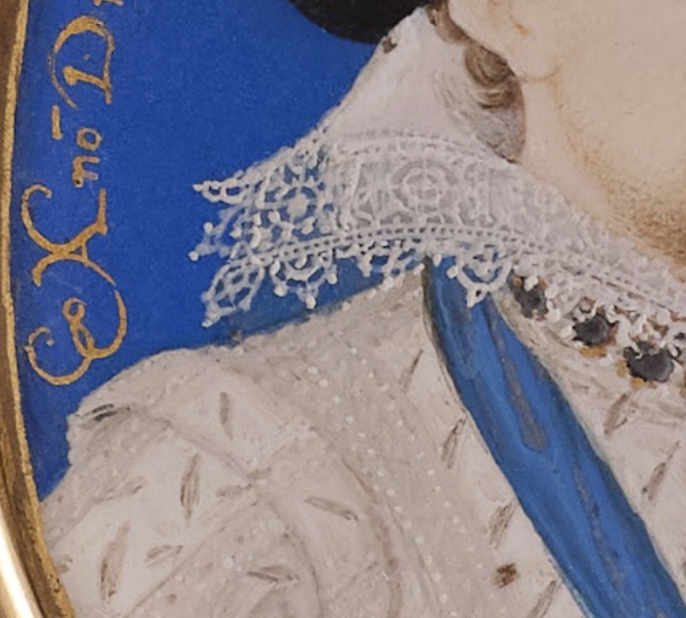
Detail, lace and doublet.
Shakespeare tells us of ‘lawn as white as driven snow’ referring to finely-woven linen from the French town of Laon, of which costly collars, cuffs and undergarments could be made. The King’s collar (correctly called ‘bands’) appears to be made of such fabric, from which some threads have been removed to form square holes which are then filled in with individual stitches to create a design of snowflake shapes. Such cutwork is called reticella lace, with spiky edges formed of ‘punto in aria’ (stitches in the air).
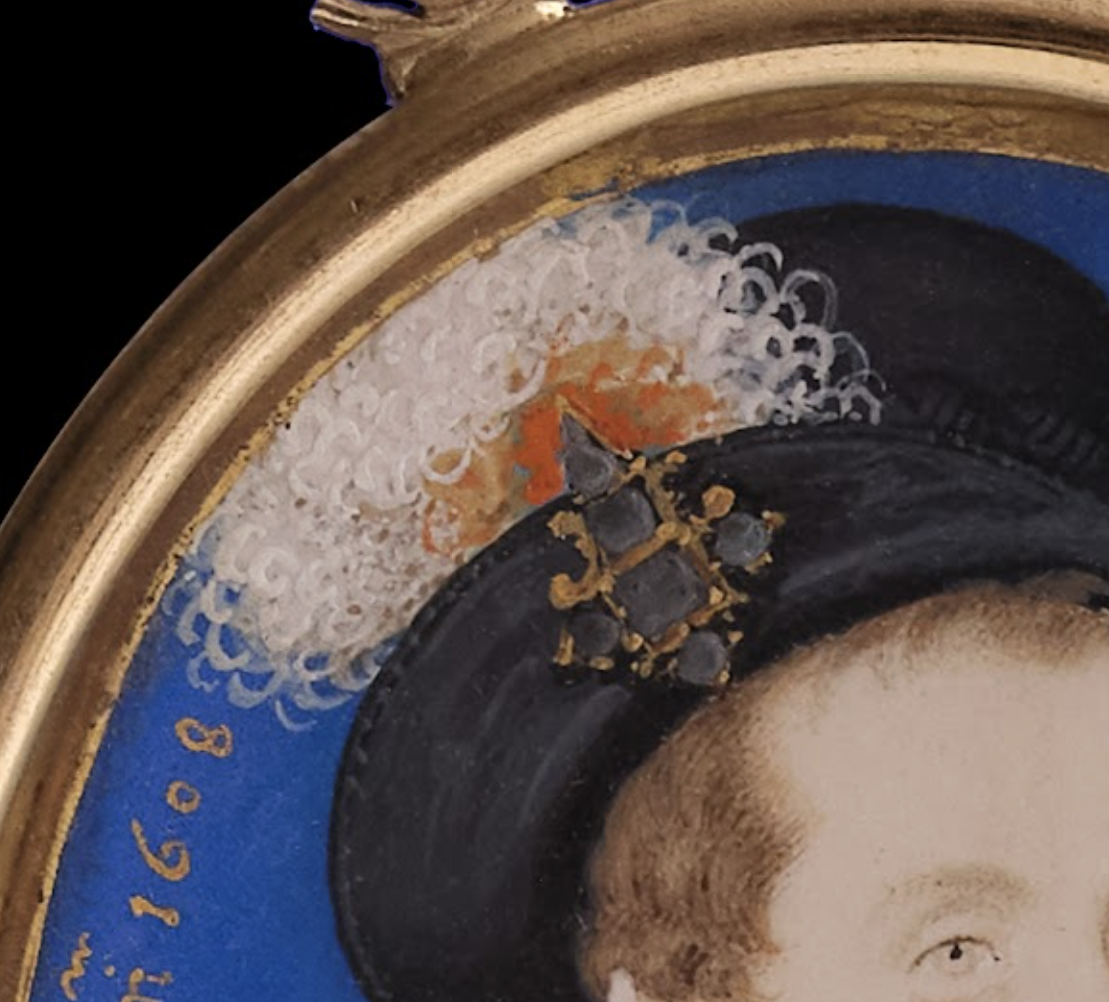
Detail, hat jewel.
The soft curls of an ostrich feather complete the trio of contrasting white textures, whilst rich red dye forms the centre of the plume and acts as a foil to the magnificent hat ornament whose pyramid shape signifies stability. The jewels on James’s hat, and those down the centre of the doublet are diamonds – which also signify strength (their English name shares the same root and symbolic meaning as the word ‘adamant’). Diamonds appear black in paintings - the technology did not exist to cut them to sparkle until the 1640s. It is tempting to look back at portraits of Elizabeth I, Mary I and even Henry VIII and see multiple gold-mounted square-cut diamonds sewn onto clothing and to wonder if they are the same objects as depicted here.
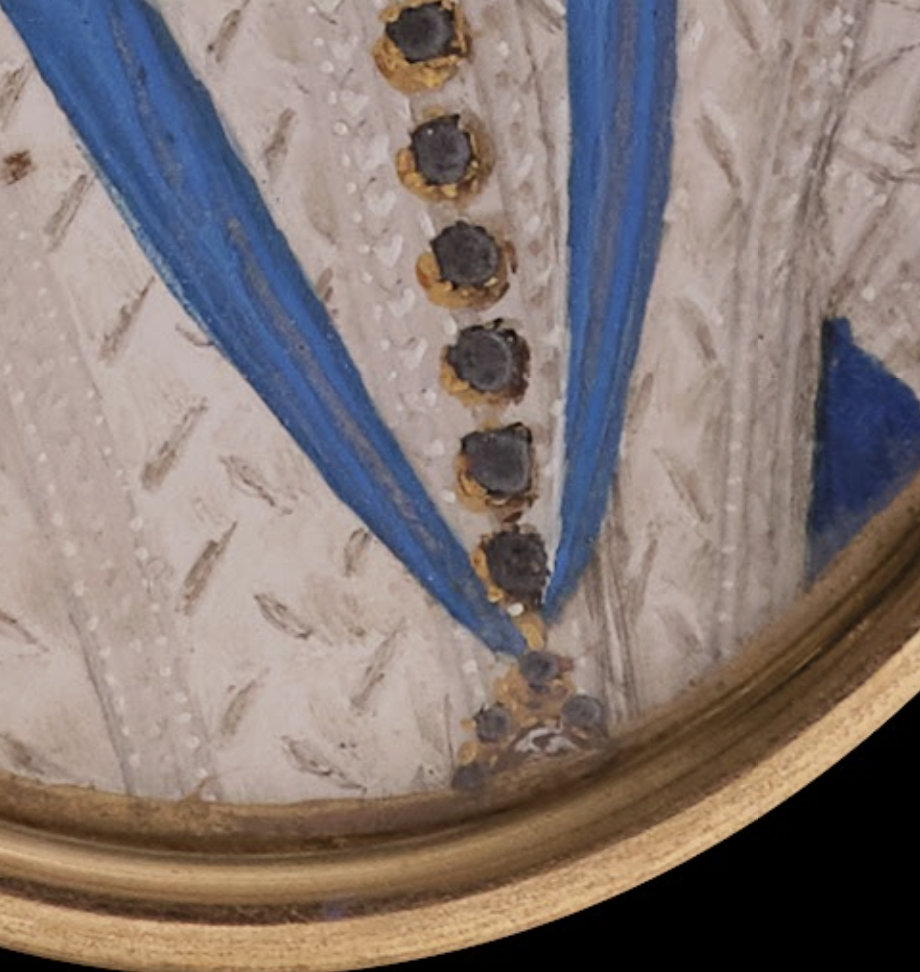
Detail, Lesser George.
Suspended from the blue ribbon that James wears around his neck would be the ‘Lesser George’ – a pendant with the enamelled and jewelled image of Saint George killing a Dragon. This signifies the Order of the Garter, an order of chivalry set up in the time of Edward III. The highest standards of behaviour were required of the 25 knights that were awarded the honour of membership. The monarch, who was always head of the order, was required to model the best behaviour of all. It is only by decoding the complex language of sartorial signalling that we can truly appreciate Hilliard’s breathtaking skill in conjuring up character to appeal to contemporaries as well as posterity.
NICHOLAS HILLIARD (c.1547-1619), Portrait miniature of King James VI & I (1566-1625) wearing the ribbon and Lesser George of the Order of the Garter, a white slashed doublet with jewelled buttons, a standing collar with wide lace edging, and a black hat with a plume of white feathers and a hat jewel, 1608, watercolour on vellum, oval, 42 mm (1 5/8 in) high. Sold by The Limner Company.
A doublet is so called as it is formed from double layers of cloth (as opposed to the word ‘singlet’ still – just about - in use today). The outer layer of silk is embellished with a regular pattern of small slashes. Before tailoring, the garment pieces would have been laid flat and the diagonal cuts would have been carefully created by hammering onto a sharp-edged tool, like a chisel. As a final touch woven braiding applied to edge the centre-front opening, and diagonally from shoulder to waist, adds additional stiffness to the doublet and accentuates its shape. Thinner braid on the shoulder tabs and down the sleeves creates rigidity. With circles of bright white Hilliard draws our attention to applied seed pearls, or woven pattern on the edge of the braiding, which sparkles.
Detail, lace and doublet.
Shakespeare tells us of ‘lawn as white as driven snow’ referring to finely-woven linen from the French town of Laon, of which costly collars, cuffs and undergarments could be made. The King’s collar (correctly called ‘bands’) appears to be made of such fabric, from which some threads have been removed to form square holes which are then filled in with individual stitches to create a design of snowflake shapes. Such cutwork is called reticella lace, with spiky edges formed of ‘punto in aria’ (stitches in the air).
Detail, hat jewel.
Detail, Lesser George.
Suspended from the blue ribbon that James wears around his neck would be the ‘Lesser George’ – a pendant with the enamelled and jewelled image of Saint George killing a Dragon. This signifies the Order of the Garter, an order of chivalry set up in the time of Edward III. The highest standards of behaviour were required of the 25 knights that were awarded the honour of membership. The monarch, who was always head of the order, was required to model the best behaviour of all. It is only by decoding the complex language of sartorial signalling that we can truly appreciate Hilliard’s breathtaking skill in conjuring up character to appeal to contemporaries as well as posterity.




