

NEWS
By Emma Blane |
13 Mar 2026
Playing dress up: the use and function of sets of oil portraits and mica talc costume overlays since the seventeenth century[1]
Bookshops and museum gift shops often stock dress-up books, for both children and adults. These publications allow the owner to place different outfits on a figure, whether intended to be an anonymous representation of a certain historical period, or a specific historical or contemporary figure. It is an activity that encourages creativity, not only in deciding which of ‘Tay-Tay’s fashion moments’[2] looks best on her, but in constructing a story of the doll’s life, or day, through the clothes they wear. In the case of dress-up dolls of real-life figures, this construction is more of a reconstruction of a true story, or at least the story that the producer of the publication believes to be true.
There is a tradition, emerging in the mid-seventeenth century, of similar items being produced in the form of oil on metal (usually copper) portraits, paired with sets of mica talcs decorated with costumes and scenes. These are particularly rare and delicate objects, especially the mica talc sheets. Therefore, there are relatively few in existence in the market, and only a select number of these objects on display in public collections. Currently, The Limner Company has just sold one of these intriguing sets, depicting an unknown woman paired with eleven costumes from the English School (fig. 1). In 2024, The Limner Company also sold a set depicting Charles I (1600-1649) with sixteen costumes, also by the English School (fig. 2).
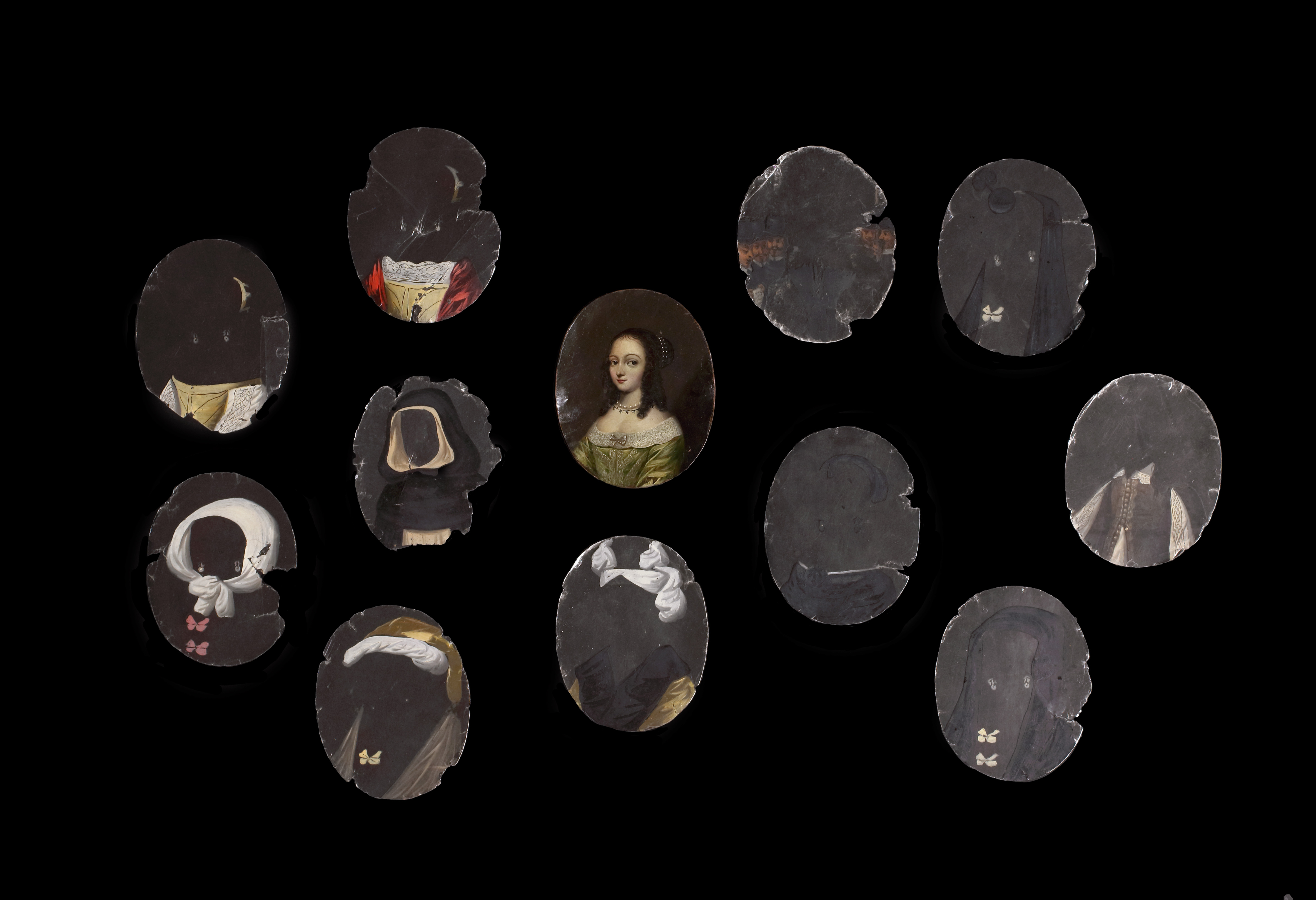 Fig. 1. ENGLISH SCHOOL, 17th Century, An Oil portrait of a Lady, likely to be an English or Swedish Noblewoman, with eleven (11) costume ‘mica’ talcs, the portrait oil on copper; the costume overlays painted on ‘mica’ talcs; the whole with original leather box with clasp, recently sold by The Limner Company.
Researching these two objects has prompted investigation into the historical function of these objects, and the source and reason for their production. The following will analyse these two examples and place them into the context of other mica talc sets in public and private collections.
What is ‘mica’ talc?
When scouring the internet for other examples of these sets, a large number of results came up for ‘mica’ and ‘talc’ as the material that the overlays are made from. Though we may associate ‘talc’ with baby powder, it can also be found in a solid mineral form. Mica is a mineral that is closely related to talc and is hence a more specific description of the material being used to create these sets. In the period in which these miniatures were produced, the two words were used interchangeably, hence the use of both in their contemporary English name. This also provides some difficulty in sourcing these sets, given that they are called many different things in historical documents. In France, for example, they are often called ‘Metamorphoses’, and English collections alternate between calling them ‘talc’ and ‘mica’ and ‘overlays’.
Micas are silicate minerals, and, usefully, split into fine, clear sheets like those that are painted on to create the costume. Today, the material’s main application is in the electrical industry,[3] due to its ability to both insulate and conduct, and to be cut so finely. Such a use means that it is now mined widely, across about 35 countries. In the seventeenth century, however, when the earliest of these miniatures appeared, mica was a rare and expensive material that would have required a large amount of manual labour to source and prepare. Given the thin nature of the sheets of this mineral, and the fact that these were meant to be handled, it is also surprising that any sets of overlays still exist today.
An insight into the function of these miniatures: A set of 16 costume overlays and an oil portrait of Charles I
It is perhaps easiest to explain the function of these miniatures by looking at the set that was sold by The Limner Company in 2024. This example depicts Charles I with sixteen separate ‘costumes’, all related to his imprisonment, execution, and martyrdom. To fully understand the attitude taken by those creating and using this miniature, it is important to understand the context in which it was created. Made in around 1650, the year following the execution of the King under the order of Oliver Cromwell (1559-1658), the creator of this set was following the popular trend of the time of honouring the recently deceased King as a martyr. The costumes he is wearing were not meant to humiliate, but to show a level of respect as the owner could, in a specific order, place the different overlays upon the oil miniature of the King and reflect upon what had happened to him so recently.
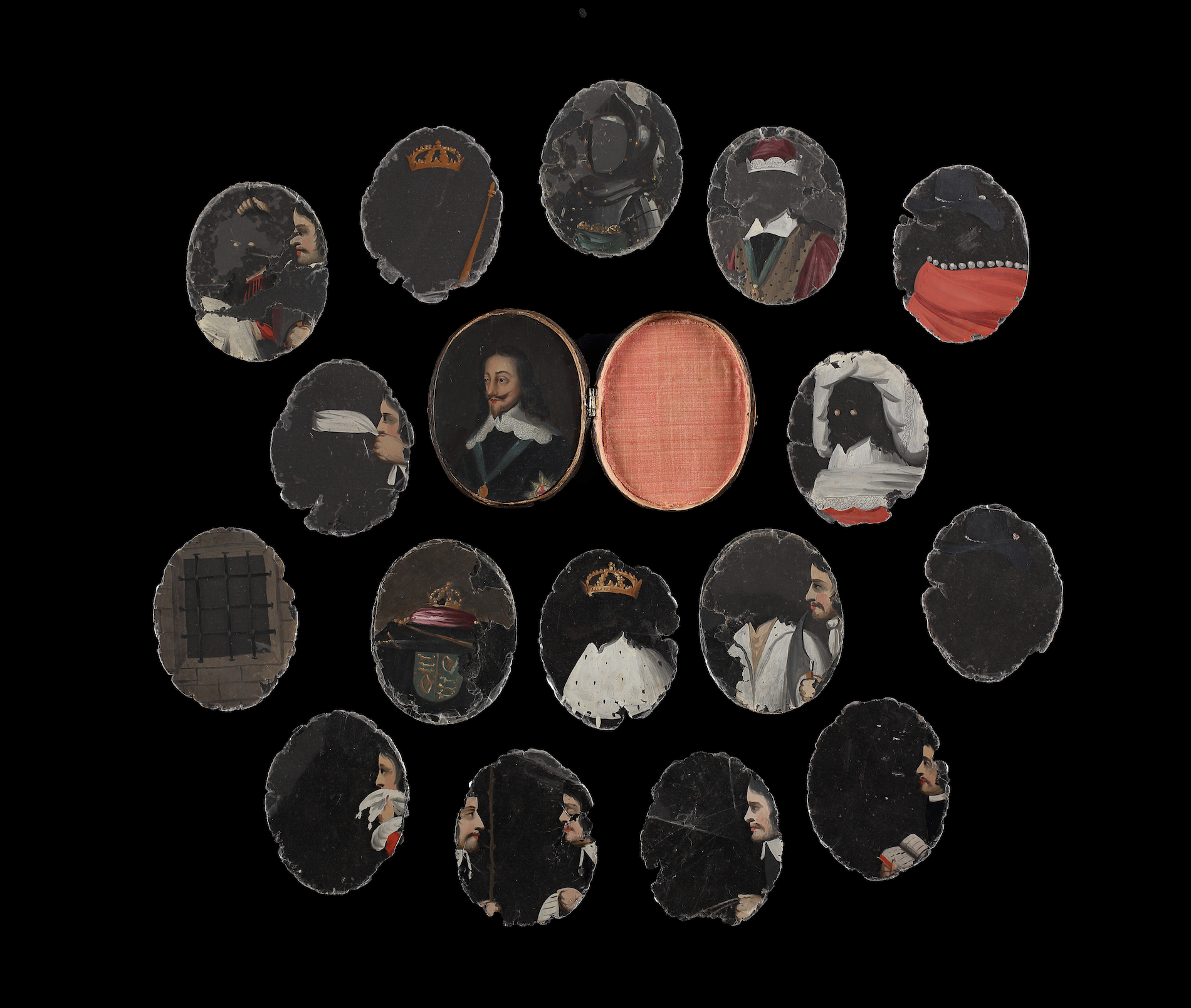
Fig. 2. ENGLISH SCHOOL, 17th Century, An Oil Portrait of Charles I (1600-1649) with 16 Costume ‘mica’ talcs; circa 1650, the portrait oil on copper, the costume overlays paint on ‘mica’ talcs; the whole with original leather box with clasp, sold by The Limner Company.
The majority of the existing sets of these items contain the same ‘costumes’, which include a suit of armour, and a red cloak paired with a broad-brimmed black hat. Furthermore, some of the talcs are not just costumes but are small painted scenes that Charles can be placed within. Examples of this include the prison cell, and, within a set in the Royal Collection,[4] a scene in which Charles is represented as a martyr, intended to be placed as the final overlay in the cycle.
This function is generally agreed upon by scholars and curators, even if the level of seriousness is one that strikes the modern mind as being quite odd. Because of the childish and trivial associations we have with dress-up dolls today, it can be difficult to grasp the fact that this miniature was not just meant to show the king in silly and, in some cases, scary, get-ups (take the overlay that shows Charles with a severed head). However, we have to take into account that the outfits were contemporary, when this miniature was created. This was how the King’s subjects expected to see him, and at this point in time remembered him.[5]
The application of this function to female sitters: A set of 11 costume overlays and an oil portrait of an unknown lady
There are two main differences between the set of talcs and a miniature currently sold by The Limner Company this week and that sold in 2024; the sitter in the present set is unknown, and she is a woman. Her costumes include a Venetian hood, an Ottoman headdress, a man’s doublet, and a scene in which five gentlemen surround her. The final scene is similar to one included in the set of Charles I and could provide some indication of her being of some political significance, as it appears she is being put on trial, though it has not been possible to identify her from this.
As with the set including Charles I, there is a story intended to be told by the costumes worn by this lady. The difference here is that this story is difficult to piece together without an identity. One can be largely confident in saying this as almost all mica talc sets come with an identified sitter whether Charles, his wife Henrietta Maria (1609-1669), the Swedish Queen Kristina (1626-1689), and courtier Kerstin Hahne (d.1656). From this list, it is notable that the majority of the sets depict female, rather than male, sitters.
There is no hint of martyrdom in these sets, unless the corresponding costume talcs have been lost. Instead, they are more focused on dressing the women in costumes and disguises. This is most evident in the talc sets including portraits of Henrietta Maria (Royal Collection, RCIN 422348) and Queen Kristina (Nordic Museum, Stockholm, NM.0266394+), both known for their disguised escapes from England and Sweden respectively. Their costumes both include men’s clothing, with one of the talcs for Queen Kristina including facial hair (fig. 3). Henrietta’s costumes also reference her mourning her husband, and outfits similar to those that she would have worn to masques, which she was known to have frequented. In the set currently with the Limner Company, there are also male costumes, and other outfits that could be interpreted as ‘disguises’ given their heavy coverage of the sitter’s face, for example the numerous hoods and Dutch huik. The inclusion of such outfits is a running theme in these objects produced in the mid-seventeenth century, and these outfits represent real cases and stories of dressing up.
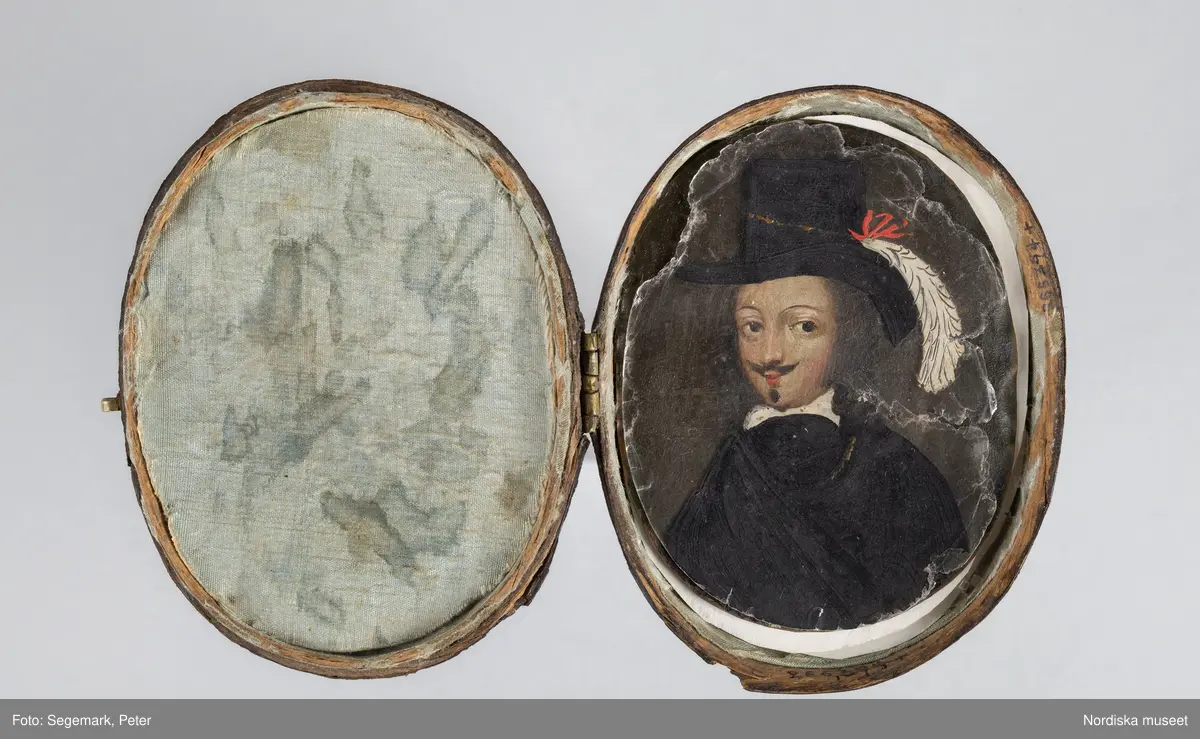
Fig. 3. Miniature portrait of Queen Kristina of Sweden with an overlay, oil on copper with thirteen mica talc overlays, Nordic National Museum, Stockholm, identifier NM.0266394+.
However, it appears that this narrative is not without a deeper meaning. It is possible to suggest that the costumes allocated to the female sitters of these sets were intended to express a moral opinion, often to the detriment of them. Two other sets in public collections, including one said to be of Kerstin Hahne[6] in the Nordic Museum, Stockholm (NM.0081682, fig. 5) and another of an unknown lady in the Isabella Stewart Gardner Museum (U18e124.a-x, fig. 6), are best used to support this argument.
In these two sets, and the one currently just sold by the Limner Company, the women are accompanied by at least one costume which places a cosmetic patch on her face. Such patches were used practically in the seventeenth century to cover up scars caused by diseases such as smallpox and were also worn as a fashionable statement, often in specific shapes. One of the most extensive representations of these patches can be found at Compton Verney, in the anonymous double portrait Two Women Wearing Cosmetic Patches (fig. 4). These two women, one black and one white, wear patches of the contrasting colours to their skin and there is an inscription, which reads ‘black with white bespott: y[o]u white w[i]th blacke this Evill / proceeds from thy proud hart, then take her: Devill’. From this, it has been suggested that the portrait is a moralising one, criticising the women for wearing an accessory associated with vanity amongst other things. If the same message is to be applied to the talc sets, then these women are also being condemned for their behaviour. Given that the portrait of Kerstin Hahne includes one overlay with a black male figure embracing her, whilst she wears a cosmetic patch (fig. 5), it can be said for certain that a similar racist denunciation of the sitter is happening as to that in the Compton Verney portrait. Furthermore, the similarity of the costumes in the Kerstin Hahne set and the set currently with the Limner Company provide support that the two were produced for a similarly moralising reason.
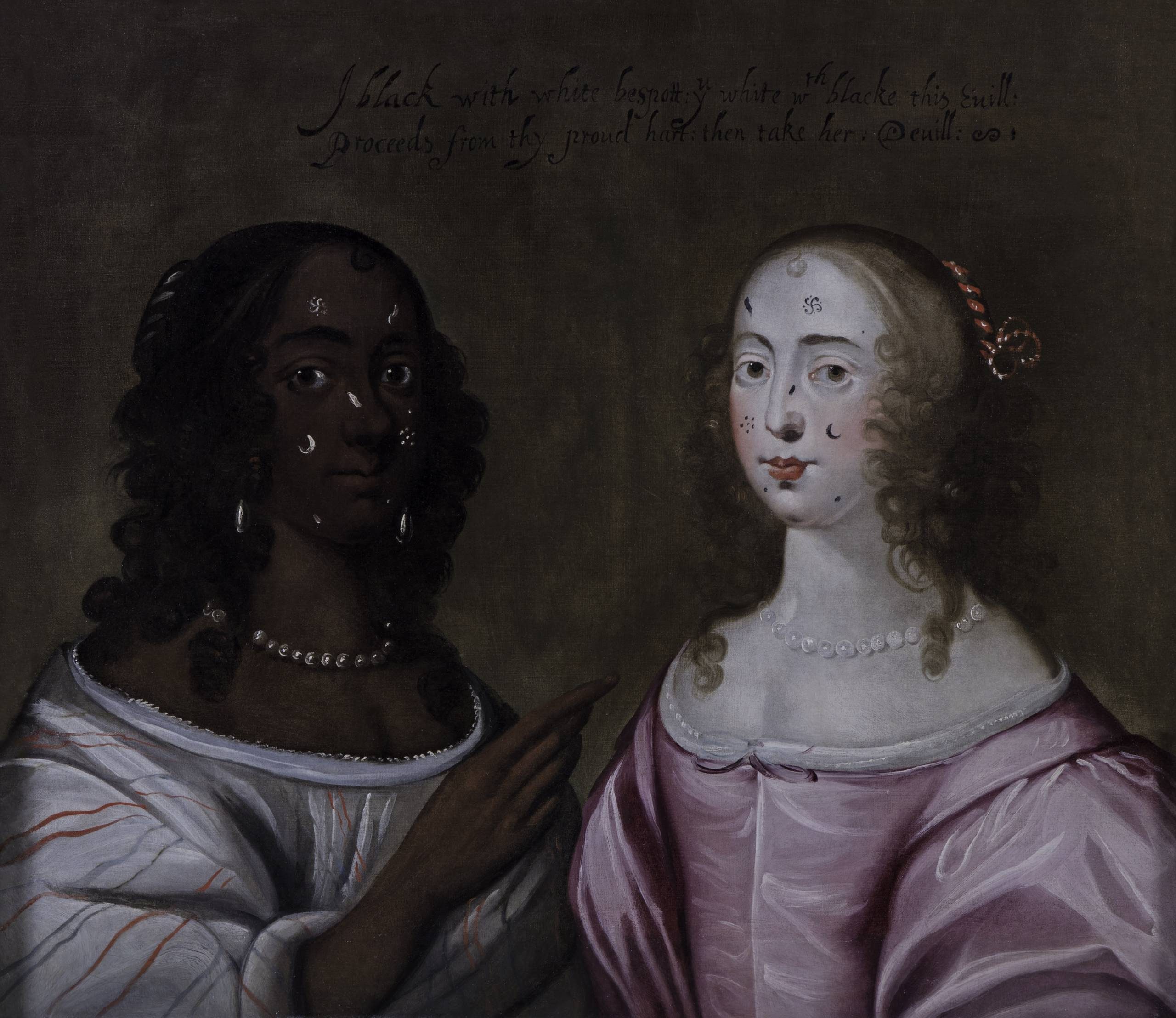 Fig. 4. Unknown artist, Two Ladies Wearing Cosmetic Patches, oil on canvas, on display at Compton Verney.
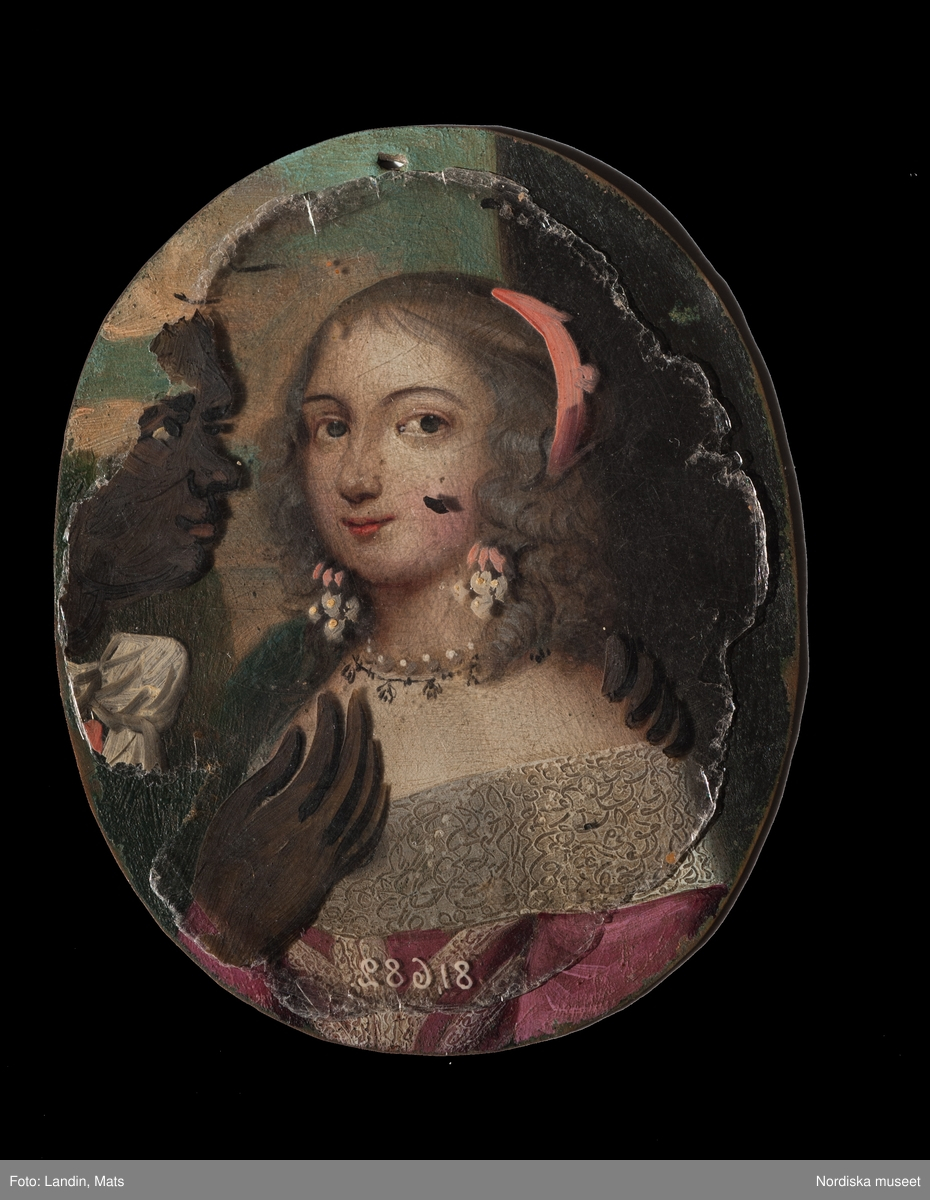 Fig. 5. Miniature Portrait of Kerstin Hahne, d.1656, with a mica overlay, oil on copper with thirteen mica talc overlays, Nordic National Museum, Stockholm, identifier NMA.0060183.
It should be noted that the sitter in the Isabella Stewart Gardner Museum set varies greatly from the others, in that she is naked underneath her costumes. Some of her costumes also vary much more and include a lion’s head and skin and a rather intriguing get-up in which she wears a lawn collar and red cap and holds a chicken on a pole (fig. 6). It could be suggested that she was an actress and that these were known outfits of hers, whoever she was, to be so niche. This context would also explain the more erotic nature of the set.
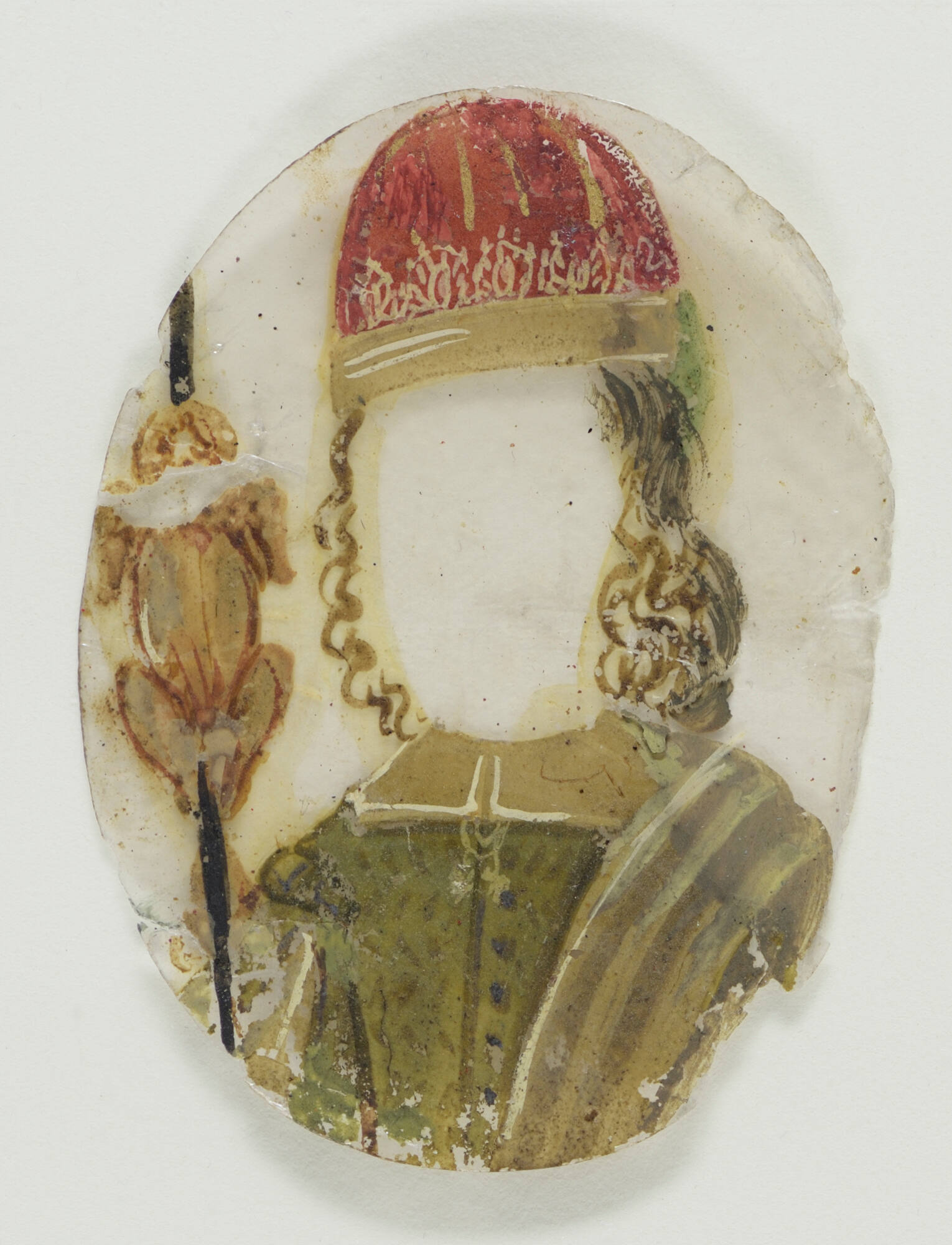 Fig. 6: A talc overlay from DUTCH, Portrait Miniature with Twenty-Three Costume Overlays, 1630-1700, oil on copper with painted mica overlays, Isabella Stewart Gardner Museum, Boston, U18e124.a-x.
Conclusion
The tradition of these sets did not die out completely in following centuries, and the Royal Collection has two examples of nineteenth century sets. One of these includes a portrait of Princess Charlotte of Wales (1796-1817) (fig. 7). Charlotte was the granddaughter of George III (1738-1820) and was the heir to the throne through her father, who would later become George IV (1762-1830). She died at the age of 21 during childbirth. The set, which is the only one discussed here to have a named artist, Denis Brownell Murphy (c. 1745-1842), was painted three years before the princess’ death and contains historical costumes, including an Elizabethan ruff and gable hood. It is more likely that this set was produced for entertainment; Charlotte may have known of the seventeenth-century sets in the collection and simply wanted one of these for herself to experiment with.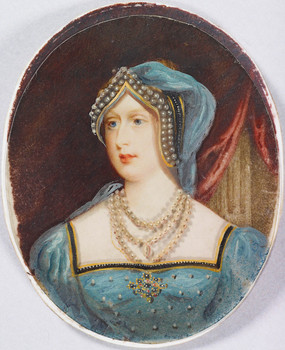
Fig. 7: DENIS BROWNWELL MURPHY (c. 1745-1842), Princess Charlotte of Wales (1796-1817) with a talc overlay, signed and dated 1814, watercolour on ivory laid on card with talc overlays, Royal Collection, RCIN 422233.
As well as being usable, physical objects, sets of oil miniature portraits with mica talc costume overlays were used as a narrative and moralising device in the second half of the seventeenth century. This moralising aspect is more evident in the sets that include portraits of women, especially those who remain unidentified, as is the case with the set that sold this week with the Limner Company.
There have been suggestions that the painting at Compton Verney and these talcs came from the same workshop. No talc sets have named attributions and instead belong to ‘Dutch’ or ‘English’ schools. Stylistically, it is possible to say that all the sets mentioned above are linked. In terms of known sitters, the Netherlands and England are the connecting locations; Henrietta Maria and Queen Kristina were both in the Netherlands during their exile. It is tempting to suggest that there was movement by members of this workshop between the two countries. The Swedish connection is also interesting and should be the subject of further study, especially given the movement of miniaturist Alexander Cooper (1609-1660) from England to The Hague, and then on to the court of Queen Kristina.
These sets are incredibly intriguing works of art and remain as symbols of the interactive nature of the portrait miniature as a medium, beyond their use as mementos of romance and mourning. Instead of being produced for a loved one, these sets were produced for a wider audience, as is the case with many miniatures of royalty, to convey a certain story, in some cases a story of warning against succumbing to the same level of immorality as these women were seen to have succumbed to.
These sets are incredibly intriguing works of art and remain as symbols of the interactive nature of the portrait miniature as a medium, beyond their use as mementos of romance and mourning. Instead of being produced for a loved one, these sets were produced for a wider audience, as is the case with many miniatures of royalty, to convey a certain story, in some cases a story of warning against succumbing to the same level of immorality as these women were seen to have succumbed to.
[1] This blog is a developed version of ‘Changing with the times: the use of the ‘dress up’ format in portrait miniatures since the seventeenth century’ by the same author, published in December 2024.
[2] Taken from the description of J Murray, Dress Up Taylor, 2024: https://www.amazon.co.uk/Dress-Up-Taylor-featuring-iconic/dp/1923049763.
[3] From the British Mica Website. Accessed 30/11/2024 at https://britishmica.co.uk/services/mica/.
[4] Royal Collection Trust, British School, 17th Century, Charles I, RCIN 422098. Online: https://www.rct.uk/collection/search#/20/collection/422098/charles-i-1600-1649.
[5] To read more on this set of costume talcs, see our online catalogue entry here.
[6] The author has not been able to find any further biographical information about Hahne other than ‘Kerstin Hahne (deceased in 1656), was the daughter of the courtier of the children of king Karl IX, Christoffer Hahne of Hesselby and Ingrid Björnsdotter. Kerstin Hahne later married governor Honorat Verdele.’ (Kvinnohistoriskt Museum, Umeå, A Clamouring Science Transformed: About Age, Women and History, no date, no page numbers, catalogue online: https://www.kvinnohistoriskt.se/download/18.cfe8cf1192b3eb7221215ee/1428655585326/Katalog%20ERTT.pdf). Any further information about the sitter would be gratefully received.
There is a tradition, emerging in the mid-seventeenth century, of similar items being produced in the form of oil on metal (usually copper) portraits, paired with sets of mica talcs decorated with costumes and scenes. These are particularly rare and delicate objects, especially the mica talc sheets. Therefore, there are relatively few in existence in the market, and only a select number of these objects on display in public collections. Currently, The Limner Company has just sold one of these intriguing sets, depicting an unknown woman paired with eleven costumes from the English School (fig. 1). In 2024, The Limner Company also sold a set depicting Charles I (1600-1649) with sixteen costumes, also by the English School (fig. 2).
Fig. 1. ENGLISH SCHOOL, 17th Century, An Oil portrait of a Lady, likely to be an English or Swedish Noblewoman, with eleven (11) costume ‘mica’ talcs, the portrait oil on copper; the costume overlays painted on ‘mica’ talcs; the whole with original leather box with clasp, recently sold by The Limner Company.What is ‘mica’ talc?
When scouring the internet for other examples of these sets, a large number of results came up for ‘mica’ and ‘talc’ as the material that the overlays are made from. Though we may associate ‘talc’ with baby powder, it can also be found in a solid mineral form. Mica is a mineral that is closely related to talc and is hence a more specific description of the material being used to create these sets. In the period in which these miniatures were produced, the two words were used interchangeably, hence the use of both in their contemporary English name. This also provides some difficulty in sourcing these sets, given that they are called many different things in historical documents. In France, for example, they are often called ‘Metamorphoses’, and English collections alternate between calling them ‘talc’ and ‘mica’ and ‘overlays’.
Micas are silicate minerals, and, usefully, split into fine, clear sheets like those that are painted on to create the costume. Today, the material’s main application is in the electrical industry,[3] due to its ability to both insulate and conduct, and to be cut so finely. Such a use means that it is now mined widely, across about 35 countries. In the seventeenth century, however, when the earliest of these miniatures appeared, mica was a rare and expensive material that would have required a large amount of manual labour to source and prepare. Given the thin nature of the sheets of this mineral, and the fact that these were meant to be handled, it is also surprising that any sets of overlays still exist today.
An insight into the function of these miniatures: A set of 16 costume overlays and an oil portrait of Charles I
It is perhaps easiest to explain the function of these miniatures by looking at the set that was sold by The Limner Company in 2024. This example depicts Charles I with sixteen separate ‘costumes’, all related to his imprisonment, execution, and martyrdom. To fully understand the attitude taken by those creating and using this miniature, it is important to understand the context in which it was created. Made in around 1650, the year following the execution of the King under the order of Oliver Cromwell (1559-1658), the creator of this set was following the popular trend of the time of honouring the recently deceased King as a martyr. The costumes he is wearing were not meant to humiliate, but to show a level of respect as the owner could, in a specific order, place the different overlays upon the oil miniature of the King and reflect upon what had happened to him so recently.
Fig. 2. ENGLISH SCHOOL, 17th Century, An Oil Portrait of Charles I (1600-1649) with 16 Costume ‘mica’ talcs; circa 1650, the portrait oil on copper, the costume overlays paint on ‘mica’ talcs; the whole with original leather box with clasp, sold by The Limner Company.
The majority of the existing sets of these items contain the same ‘costumes’, which include a suit of armour, and a red cloak paired with a broad-brimmed black hat. Furthermore, some of the talcs are not just costumes but are small painted scenes that Charles can be placed within. Examples of this include the prison cell, and, within a set in the Royal Collection,[4] a scene in which Charles is represented as a martyr, intended to be placed as the final overlay in the cycle.
This function is generally agreed upon by scholars and curators, even if the level of seriousness is one that strikes the modern mind as being quite odd. Because of the childish and trivial associations we have with dress-up dolls today, it can be difficult to grasp the fact that this miniature was not just meant to show the king in silly and, in some cases, scary, get-ups (take the overlay that shows Charles with a severed head). However, we have to take into account that the outfits were contemporary, when this miniature was created. This was how the King’s subjects expected to see him, and at this point in time remembered him.[5]
The application of this function to female sitters: A set of 11 costume overlays and an oil portrait of an unknown lady
There are two main differences between the set of talcs and a miniature currently sold by The Limner Company this week and that sold in 2024; the sitter in the present set is unknown, and she is a woman. Her costumes include a Venetian hood, an Ottoman headdress, a man’s doublet, and a scene in which five gentlemen surround her. The final scene is similar to one included in the set of Charles I and could provide some indication of her being of some political significance, as it appears she is being put on trial, though it has not been possible to identify her from this.
As with the set including Charles I, there is a story intended to be told by the costumes worn by this lady. The difference here is that this story is difficult to piece together without an identity. One can be largely confident in saying this as almost all mica talc sets come with an identified sitter whether Charles, his wife Henrietta Maria (1609-1669), the Swedish Queen Kristina (1626-1689), and courtier Kerstin Hahne (d.1656). From this list, it is notable that the majority of the sets depict female, rather than male, sitters.
There is no hint of martyrdom in these sets, unless the corresponding costume talcs have been lost. Instead, they are more focused on dressing the women in costumes and disguises. This is most evident in the talc sets including portraits of Henrietta Maria (Royal Collection, RCIN 422348) and Queen Kristina (Nordic Museum, Stockholm, NM.0266394+), both known for their disguised escapes from England and Sweden respectively. Their costumes both include men’s clothing, with one of the talcs for Queen Kristina including facial hair (fig. 3). Henrietta’s costumes also reference her mourning her husband, and outfits similar to those that she would have worn to masques, which she was known to have frequented. In the set currently with the Limner Company, there are also male costumes, and other outfits that could be interpreted as ‘disguises’ given their heavy coverage of the sitter’s face, for example the numerous hoods and Dutch huik. The inclusion of such outfits is a running theme in these objects produced in the mid-seventeenth century, and these outfits represent real cases and stories of dressing up.
Fig. 3. Miniature portrait of Queen Kristina of Sweden with an overlay, oil on copper with thirteen mica talc overlays, Nordic National Museum, Stockholm, identifier NM.0266394+.
However, it appears that this narrative is not without a deeper meaning. It is possible to suggest that the costumes allocated to the female sitters of these sets were intended to express a moral opinion, often to the detriment of them. Two other sets in public collections, including one said to be of Kerstin Hahne[6] in the Nordic Museum, Stockholm (NM.0081682, fig. 5) and another of an unknown lady in the Isabella Stewart Gardner Museum (U18e124.a-x, fig. 6), are best used to support this argument.
In these two sets, and the one currently just sold by the Limner Company, the women are accompanied by at least one costume which places a cosmetic patch on her face. Such patches were used practically in the seventeenth century to cover up scars caused by diseases such as smallpox and were also worn as a fashionable statement, often in specific shapes. One of the most extensive representations of these patches can be found at Compton Verney, in the anonymous double portrait Two Women Wearing Cosmetic Patches (fig. 4). These two women, one black and one white, wear patches of the contrasting colours to their skin and there is an inscription, which reads ‘black with white bespott: y[o]u white w[i]th blacke this Evill / proceeds from thy proud hart, then take her: Devill’. From this, it has been suggested that the portrait is a moralising one, criticising the women for wearing an accessory associated with vanity amongst other things. If the same message is to be applied to the talc sets, then these women are also being condemned for their behaviour. Given that the portrait of Kerstin Hahne includes one overlay with a black male figure embracing her, whilst she wears a cosmetic patch (fig. 5), it can be said for certain that a similar racist denunciation of the sitter is happening as to that in the Compton Verney portrait. Furthermore, the similarity of the costumes in the Kerstin Hahne set and the set currently with the Limner Company provide support that the two were produced for a similarly moralising reason.
Fig. 4. Unknown artist, Two Ladies Wearing Cosmetic Patches, oil on canvas, on display at Compton Verney.Fig. 5. Miniature Portrait of Kerstin Hahne, d.1656, with a mica overlay, oil on copper with thirteen mica talc overlays, Nordic National Museum, Stockholm, identifier NMA.0060183.It should be noted that the sitter in the Isabella Stewart Gardner Museum set varies greatly from the others, in that she is naked underneath her costumes. Some of her costumes also vary much more and include a lion’s head and skin and a rather intriguing get-up in which she wears a lawn collar and red cap and holds a chicken on a pole (fig. 6). It could be suggested that she was an actress and that these were known outfits of hers, whoever she was, to be so niche. This context would also explain the more erotic nature of the set.
Fig. 6: A talc overlay from DUTCH, Portrait Miniature with Twenty-Three Costume Overlays, 1630-1700, oil on copper with painted mica overlays, Isabella Stewart Gardner Museum, Boston, U18e124.a-x.Conclusion
The tradition of these sets did not die out completely in following centuries, and the Royal Collection has two examples of nineteenth century sets. One of these includes a portrait of Princess Charlotte of Wales (1796-1817) (fig. 7). Charlotte was the granddaughter of George III (1738-1820) and was the heir to the throne through her father, who would later become George IV (1762-1830). She died at the age of 21 during childbirth. The set, which is the only one discussed here to have a named artist, Denis Brownell Murphy (c. 1745-1842), was painted three years before the princess’ death and contains historical costumes, including an Elizabethan ruff and gable hood. It is more likely that this set was produced for entertainment; Charlotte may have known of the seventeenth-century sets in the collection and simply wanted one of these for herself to experiment with.
Fig. 7: DENIS BROWNWELL MURPHY (c. 1745-1842), Princess Charlotte of Wales (1796-1817) with a talc overlay, signed and dated 1814, watercolour on ivory laid on card with talc overlays, Royal Collection, RCIN 422233.
As well as being usable, physical objects, sets of oil miniature portraits with mica talc costume overlays were used as a narrative and moralising device in the second half of the seventeenth century. This moralising aspect is more evident in the sets that include portraits of women, especially those who remain unidentified, as is the case with the set that sold this week with the Limner Company.
There have been suggestions that the painting at Compton Verney and these talcs came from the same workshop. No talc sets have named attributions and instead belong to ‘Dutch’ or ‘English’ schools. Stylistically, it is possible to say that all the sets mentioned above are linked. In terms of known sitters, the Netherlands and England are the connecting locations; Henrietta Maria and Queen Kristina were both in the Netherlands during their exile. It is tempting to suggest that there was movement by members of this workshop between the two countries. The Swedish connection is also interesting and should be the subject of further study, especially given the movement of miniaturist Alexander Cooper (1609-1660) from England to The Hague, and then on to the court of Queen Kristina.
These sets are incredibly intriguing works of art and remain as symbols of the interactive nature of the portrait miniature as a medium, beyond their use as mementos of romance and mourning. Instead of being produced for a loved one, these sets were produced for a wider audience, as is the case with many miniatures of royalty, to convey a certain story, in some cases a story of warning against succumbing to the same level of immorality as these women were seen to have succumbed to.
These sets are incredibly intriguing works of art and remain as symbols of the interactive nature of the portrait miniature as a medium, beyond their use as mementos of romance and mourning. Instead of being produced for a loved one, these sets were produced for a wider audience, as is the case with many miniatures of royalty, to convey a certain story, in some cases a story of warning against succumbing to the same level of immorality as these women were seen to have succumbed to.
[1] This blog is a developed version of ‘Changing with the times: the use of the ‘dress up’ format in portrait miniatures since the seventeenth century’ by the same author, published in December 2024.
[2] Taken from the description of J Murray, Dress Up Taylor, 2024: https://www.amazon.co.uk/Dress-Up-Taylor-featuring-iconic/dp/1923049763.
[3] From the British Mica Website. Accessed 30/11/2024 at https://britishmica.co.uk/services/mica/.
[4] Royal Collection Trust, British School, 17th Century, Charles I, RCIN 422098. Online: https://www.rct.uk/collection/search#/20/collection/422098/charles-i-1600-1649.
[5] To read more on this set of costume talcs, see our online catalogue entry here.
[6] The author has not been able to find any further biographical information about Hahne other than ‘Kerstin Hahne (deceased in 1656), was the daughter of the courtier of the children of king Karl IX, Christoffer Hahne of Hesselby and Ingrid Björnsdotter. Kerstin Hahne later married governor Honorat Verdele.’ (Kvinnohistoriskt Museum, Umeå, A Clamouring Science Transformed: About Age, Women and History, no date, no page numbers, catalogue online: https://www.kvinnohistoriskt.se/download/18.cfe8cf1192b3eb7221215ee/1428655585326/Katalog%20ERTT.pdf). Any further information about the sitter would be gratefully received.




