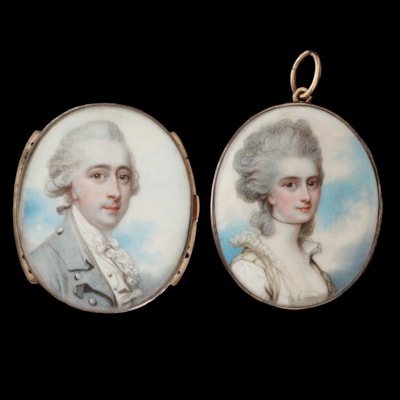
DIANA HILL (nèe Dietz) (c.1765-1844)
Portrait miniature of a Gentleman, wearing blue coat with braided buttons, white waistcoat and frilled shirt with stock, his hair powdered and worn 'en queue'
circa 1790
Watercolour on ivory (licence SHBAPQJT)
Oval, 80mm (3 1/8in) high
Gilt-metal frame with plaited hair reverse
£5,500

As a young widow with two young children, Hill decided to seek work in India, following closely in the footsteps of John Smart who had left for Madras the previous year. Her connections with the East India Company through her brother in law, John Hill, proved helpful in securing commissions. One of her first sittings came from William Larkins, accountant-general at Calcutta, and she appears to have enjoyed great success as an artist in Calcutta. Two years later her success was noted by the painter Thomas Daniell, who in November 1788 wrote to Humphry, who had returned to England: 'Mrs. Hill is still making handsome faces, in the house you lived in last in Calcutta'.[1]
The brave move to India paid off for Hill, who for a few years appears to have gained commissions from principal European figures in Calcutta. These commissions included a portrait miniature of Charles Cornwallis, 1st Marquess Cornwallis, in 1786.[2] Cornwallis had been appointed in February 1786 to serve as both Commander-in-Chief of British India and Governor of the Presidency of Fort William, also known as the Bengal Presidency.
For the most part, Hill’s career followed closely that of her male peers. She was trained by Jeremiah Meyer, who held a position at court as official painter to George III. From 1777 she regularly exhibited at the Royal Academy from Angel Court in Windmill Street, and from these records a distinctly female patronage emerges. Her move to India in the mid-1780s coincided with other (male) artists similarly seeking the patronage of those in the employ of the East India Company, including Johan Zoffany, John Smart and Ozias Humphry. Where her career differed was in the breaks which corresponded with her two marriages, as well as in the demographic and subject matter she painted. The jealousy she aroused in the miniaturist Ozias Humphry indicates the advantage he felt she had as a rare female artist in a landscape dominated by men, firstly describing her as a ‘pretty young widow with two young children’ and secondly declaring : he would 'rather have had all the male painters in England landed in Bengal than a single woman'. Although she exhibited a handful of works after her first marriage in 1785, the subjects were flower pictures. After her second marriage in 1788, she gave up painting professionally, although a portrait of her husband exists dated 1791.[3]
[1] W. Foster, ‘British artists in India, 1760–1820’, Walpole Society, 19 (1930–31), 1–88, p. 40
[2] Now at Mount Vernon, Gift of Katherine Merle-Smith Thomas, 2010, H-4912
[3] Lieutenant Thomas Harriott, the artist's second husband, is now in the Victoria and Albert Museum
P.126-1920


shipping notice
Worldwide shipping is included in all prices.
The Limner Company does not accept any responsibility for import duty, this is to be paid by the buyer.
Some stock items contain materials from endangered species which are governed by CITES regulations and will require a permit to export outside of Great Britain. If a certificate of export is required then this will be the responsibility of and paid for by the buyer .


DIANA HILL (nèe Dietz)
(c.1764-1844)Portrait miniature of a Gentleman, wearing blue coat with braided buttons, white waistcoat and frilled shirt with stock, his hair powdered and worn 'en queue'
you may also like