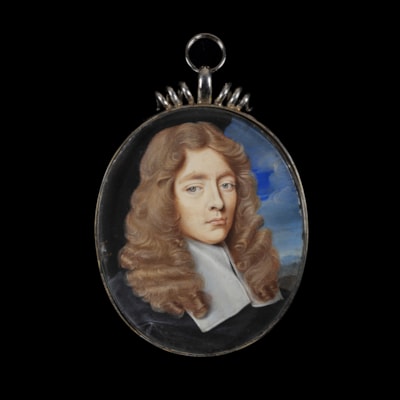
Attributed to THOMAS RAWLINS
(1620?-1670)A fruit stone (probably a plum or peach stone) carved on both sides with portraits of King Charles I and King Charles II, with royal insignia
17th century
Carved fruit stone with colour and gilding
Oval, 38mm (1 ½ in) high
Set into the original gold and rock crystal locket, the gold engraved with fleur de lys pattern
PRICE ON REQUEST
 +44(0)7983510056

'Carving a fruit stone would seem to be an inexpensive type of commemorative art form, but in fact this would have been undertaken by highly skilled craftsmen, able to use the contours of the stone to follow the faces of the sitters. The present example is one of two which have survived with colour added to the faces.'
This carved fruit stone would seem to be one of a handful to survive as commemorative portraits of the newly restored King Charles II and his father, the executed Charles I (see figs 1 and 2). After Charles I was beheaded in January 1649, many small enamels were made to commemorate this day, considered by many an act against the natural order and God. The diarist John Evelyn noted ‘Such horror that I kept the day of his martyrdom a fast’; a sentiment shared by those who commissioned physical mementoes which kept the promise of a returned monarchy over the next decade.
Carving a fruit stone would seem to be an inexpensive type of commemorative art form, but in fact this would have been undertaken by highly skilled craftsmen, able to use the contours of the stone to follow the faces of the sitters. The present example is one of two which have survived with colour added to the faces.
In 1725 the antiquarian George Vertue recorded seeing a peach stone carved and surmounted with the initials of the maker ‘NB’. Described as ‘a Curious piece in small carv’d on a peach stone, the picture of K. Charles I a full face. A laurel round it. the face hair band &c. very neatly cutt’.[1] This was, Vertue concluded, by the engraver at the Royal Mint Nicholas Briot. The skilfulness of the carver was evidently also valued by the owners of this carved stone, who, Vertue noted, valued it ‘at thousands’. Vertue also noted another example ‘at Windsor preserv’d in the Custody of the Treasury or repository for the plate in the church’.[2]
The attribution to Thomas Rawlins is partially based on his training under Nicholas Briot. An English medallist and playwright, Rawlins worked for Charles I throughout the English Civil War, moving to Oxford to be with the King. He left England for France in 1648, returning in 1652 and eking out a living engraving towns and tradesmen tokens. In 1660, however, he was reinstated as chief engraver at the mint. He was perfectly placed to produce such an item of high quality workmanship of both kings – Charles I and Charles II.
The design of the extant carved stones seems to derive from silver loyalist badges, one of which was found at Hartlebury Castle, Worcestershire. Like loyalist badges this rock-crystal encased carving would have been worn as a pendant or displayed in other ways about the body. Owning a piece like this would have indicated Royalist sympathies and discovery would have led to imprisonment or death. As such it seems that most of the surviving pieces were probably kept in shrines in the homes of royalist sympathisers and handled regularly-hence the high emotional and monetary value placed on the carving by Briot which Vertue saw in the 18th century.
[1] “VERTUE’S NOTE BOOK A.g. (British Museum Add. MS. 23,070).” The Volume of the Walpole Society 20 (1931): 38. http://www.jstor.org/stable/41830422.
[2] Ibid., George Vertue, Vol. V, 466, British Museum 37b. This example was sold at Christie's, London, 20 February 1973, lot 168.
Carving a fruit stone would seem to be an inexpensive type of commemorative art form, but in fact this would have been undertaken by highly skilled craftsmen, able to use the contours of the stone to follow the faces of the sitters. The present example is one of two which have survived with colour added to the faces.
In 1725 the antiquarian George Vertue recorded seeing a peach stone carved and surmounted with the initials of the maker ‘NB’. Described as ‘a Curious piece in small carv’d on a peach stone, the picture of K. Charles I a full face. A laurel round it. the face hair band &c. very neatly cutt’.[1] This was, Vertue concluded, by the engraver at the Royal Mint Nicholas Briot. The skilfulness of the carver was evidently also valued by the owners of this carved stone, who, Vertue noted, valued it ‘at thousands’. Vertue also noted another example ‘at Windsor preserv’d in the Custody of the Treasury or repository for the plate in the church’.[2]
The attribution to Thomas Rawlins is partially based on his training under Nicholas Briot. An English medallist and playwright, Rawlins worked for Charles I throughout the English Civil War, moving to Oxford to be with the King. He left England for France in 1648, returning in 1652 and eking out a living engraving towns and tradesmen tokens. In 1660, however, he was reinstated as chief engraver at the mint. He was perfectly placed to produce such an item of high quality workmanship of both kings – Charles I and Charles II.
The design of the extant carved stones seems to derive from silver loyalist badges, one of which was found at Hartlebury Castle, Worcestershire. Like loyalist badges this rock-crystal encased carving would have been worn as a pendant or displayed in other ways about the body. Owning a piece like this would have indicated Royalist sympathies and discovery would have led to imprisonment or death. As such it seems that most of the surviving pieces were probably kept in shrines in the homes of royalist sympathisers and handled regularly-hence the high emotional and monetary value placed on the carving by Briot which Vertue saw in the 18th century.
[1] “VERTUE’S NOTE BOOK A.g. (British Museum Add. MS. 23,070).” The Volume of the Walpole Society 20 (1931): 38. http://www.jstor.org/stable/41830422.
[2] Ibid., George Vertue, Vol. V, 466, British Museum 37b. This example was sold at Christie's, London, 20 February 1973, lot 168.
Private Collection, UK.


shipping notice
Worldwide shipping is included in all prices.
The Limner Company does not accept any responsibility for import duty, this is to be paid by the buyer.
Some stock items contain materials from endangered species which are governed by CITES regulations and will require a permit to export outside of Great Britain. If a certificate of export is required then this will be the responsibility of and paid for by the buyer .
you may also like